
Why Use Mean Kinetic Temperature (MKT)?
Temperature-sensitive products (like pharmaceuticals, vaccines, food, or chemicals) can be damaged not just by one big temperature spike, but also by many small changes over time. Mean Kinetic Temperature (MKT) helps you understand the overall impact of these temperature changes.
MKT answers a simple question: “If my shipment experienced different temperatures along the way, what single temperature best represents how stressful that journey was for the product?”
Why this matters
- A simple average temperature can be misleading and hide short but harmful spikes.
- MKT gives more importance to higher temperatures that can cause damage faster.
- It helps you judge product stability after transport or storage.
- It supports quality decisions for regulated and sensitive products.
Real-life example
Imagine ice cream that briefly melts and refreezes. The average temperature might look fine, but the quality is clearly affected. MKT captures this kind of risk much better than a simple average.
How It Works
MKT looks at all temperature readings over time and combines them into one meaningful number. Temperatures that are too warm have a bigger impact than slightly cooler temperatures.
You don’t need to calculate MKT yourself; Tive automatically does this for you.
Step-by-step in Tive
- Temperature data is collected - Your Tive tracker records temperature at regular intervals throughout the shipment.
- All readings are analyzed together - Instead of averaging them, the system weighs warmer temperatures more heavily.
- MKT is calculated automatically - Tive uses an industry-standard MKT formula with high precision to ensure accuracy.
- Results are shown in your report - You can find the MKT value in the Shipment Report, under the Temperature Data Summary section.
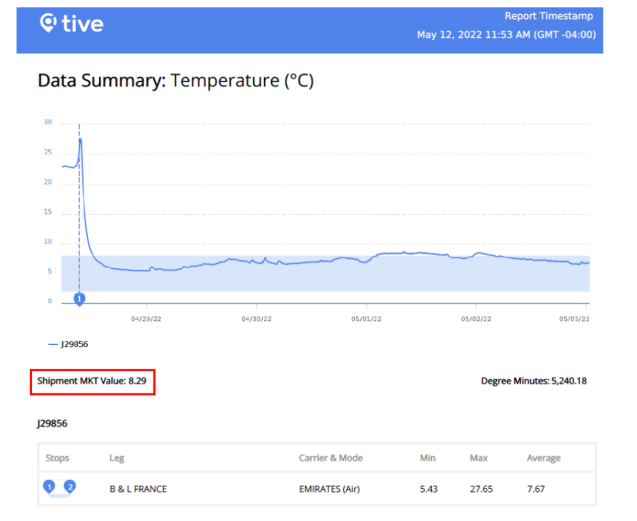
What you get
- A single temperature value that reflects the real thermal stress on your product
- A clearer picture of whether the shipment stayed within safe conditions
Degree Minutes vs. Mean Kinetic Temperature (MKT)
Both Degree Minutes and MKT help you understand temperature impact, but they answer slightly different questions.
What are Degree Minutes?
Degree Minutes measure how far and for how long the temperature stayed outside your configured alert limits.
In simple terms, Degree Minutes tell you:
- How much the temperature went above or below the allowed range
- How long the product was exposed to those conditions
For example, being slightly too warm for a long time can be just as risky as being very warm for a short time. Degree Minutes capture this cumulative exposure.
How Degree Minutes are used
- They are calculated based on your upper and lower alert thresholds
- Time spent outside the safe range is multiplied by how far the temperature drifted
- Results are shown separately for temperatures above and below the ideal range
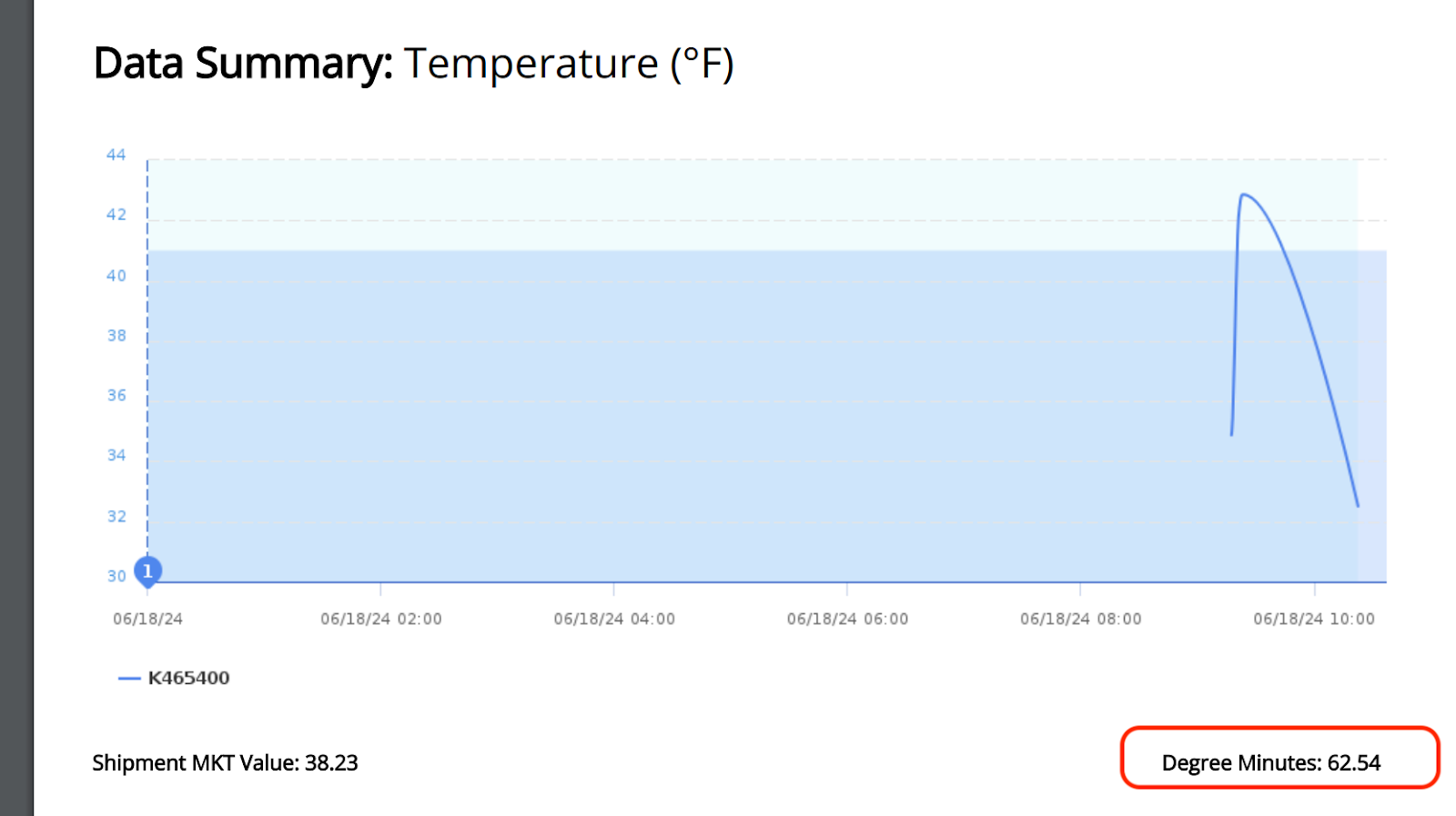
How Degree Minutes and MKT work together
- Degree Minutes help you understand alert severity and duration
- MKT helps you understand the overall stress on the product across the entire journey
Using both together gives you a clearer, more complete view of shipment quality.
Key Points to Know
- MKT and Degree Minutes measure different things - MKT summarizes the overall temperature stress across the entire journey, while Degree Minutes show how severe and how long temperatures were outside the allowed range.
- A safe MKT does not automatically mean a safe shipment - Short but intense temperature excursions may still impact product quality. Degree Minutes help highlight these situations.
- Degree Minutes depend on alert settings - They are calculated using the upper and lower alert thresholds configured for the shipment. Accurate limits are essential for meaningful results.
- Higher temperatures have a bigger impact - Both MKT and Degree Minutes give more weight to warmer temperatures, since heat typically causes damage faster than cold exposure.
- Consistent data collection is critical - Regular, uninterrupted temperature readings are needed for reliable MKT and Degree Minutes calculations.
- Best suited for sensitive products - These metrics are especially important for pharmaceuticals, vaccines, biologics, food, and other temperature-sensitive goods.
Best Practices
- Review MKT and Degree Minutes together - Use MKT for the overall picture and Degree Minutes to understand how serious each excursion was.
- Investigate all temperature excursions - Even if MKT looks acceptable, high Degree Minutes can indicate prolonged or severe exposure that requires follow-up.
- Set realistic and product-specific alert thresholds - Proper alert limits ensure Degree Minutes accurately reflect true risk to the product.
- Segment the shipment journey - Review MKT and Degree Minutes by shipment phase (loading, transit, unloading, storage) to identify where issues are most likely to occur.
- Use metrics to support quality decisions, not replace them - Always combine MKT and Degree Minutes with product stability data, SOPs, and regulatory guidance.
If you have any additional questions, you can reach out to support@tive.com for help.